研究概要 / Overview
私たちは、移動現象論や数値流体力学(CFD)を基盤に、数値シミュレーションと機械学習を融合させた研究を展開しています。「分散系流れのモデリング」と「機械学習によるダイナミクスの高速予測とプロセス最適化」を2本柱に、現象の解明からプロセス設計、社会実装までを目指します。
Based on transport phenomena and computational fluid dynamics (CFD), our research integrates numerical simulation with machine learning. With the dual pillars of "modeling of disperse flows" and "process optimization via machine learning," we aim to bridge the gap between fundamental phenomenon clarification and social implementation.
キーワード / Keywords
- 分散系流れ / Dispersed flows
- 複雑流体 / Complex fluids
- 多孔質体内流れ / Flow in porous media
- 数値流体力学 / Computational fluid dynamics (CFD)
- 混相流シミュレーション (Phase-field model / VOF) / Multiphase flow simulation (Phase-field model / VOF)
- 粉体シミュレーション (DEM / DPM) / Granular flow simulation (DEM / DPM)
- 任意形状壁境界モデル (埋込境界法 / 自由エネルギーモデル / 符号付距離関数 (SDF)) / Arbitrary-shaped wall boundary model (Immersed boundary method / Free-energy model / Signed distance function (SDF))
- 機械学習 / Machine learning
- データ駆動最適化 (遺伝的アルゴリズム) / Data-driven optimization (genetic algorithm)
- サロゲートモデル (UNet) / Surrogate model (UNet architecture)
柱1:分散系流れのモデリングと数値シミュレーション
Pillar 1: Modeling and numerical simulation of dispersed flows
従来の気液二相流や固気二相流だけでなく、固液液三相流、気液液三相流、固気液液四相流などのための新しい混相流シミュレーションモデルを開発しています。分散系(コロイドサスペンション、エマルション、エアロゾル、ファインバブル、ピッカリングエマルション、キャピラリーサスペンションなど)の流れでは、分散相(粒子、液滴、気泡)間の相互作用や構造形成が巨視的な流れの特性やプロセスの性能に顕著に影響を及ぼします。このような分散相の挙動やダイナミクスを十分に可視化するため、分散相、連続相およびそれ以外の物体との間に生じる多数の物理を考慮した高解像度・高忠実度の数値シミュレーションモデルを独自に開発しています。
We develop high-resolution, high-fidelity simulation models for multiphase and dispersed flows beyond conventional gas–liquid and gas–solid two-phase flows, including solid–liquid–liquid three-phase, gas–liquid–liquid three-phase, and solid–gas–liquid–liquid four-phase systems. In dispersed systems (e.g., colloidal suspensions, emulsions, aerosols, fine bubbles, Pickering emulsions, and capillary suspensions), interactions and structure formation among dispersed phases (particles, droplets, bubbles) strongly influence macroscopic flow behavior and process performance. To visualize and analyze these dynamics, we build original simulation frameworks that incorporate multiple interacting physical mechanisms among dispersed phases, continuous phases, and surrounding objects.
手法 / Methods
私たちのシミュレーションモデルは、流体運動を計算する数値流体力学(CFD)、粒子運動を計算する離散要素法(DEM)や離散相モデル(DPM)、液滴や気泡の自由界面運動を計算するフェーズフィールドモデルが相互連成されており、粒子-流体間相互作用だけでなく、気泡と液滴間、粒子と液滴や気泡(自由界面)間の相互作用の数値解析を行うことが可能です。また、複雑な形状を有する壁境界との衝突や濡れを記述するための埋込境界法・自由エネルギーモデル・符号付距離関数(SDF)に基づく任意形状壁境界モデルを開発しています。私たちのモデルを用いれば、3次元画像解析により取得した実際の多孔質体の微細構造のような非常に複雑な形状を有する物体まわりにおける粒子や液滴のダイナミクスの解析が可能です。
Our simulation framework combines (i) CFD for fluid motion, (ii) DEM and DPM for particle motion, (iii) phase-field modeling for free interface motions of droplets and bubbles, and (iv) original wall-boundary models based on the immersed boundary method, free-energy formulations, and the signed distance function (SDF) to describe collision and wetting on complex wall geometries.
柱2:機械学習による流れの高速予測とプロセス条件・設計の最適化
Pillar 2: Machine-learning-based fast prediction of flows and optimization of process conditions and design
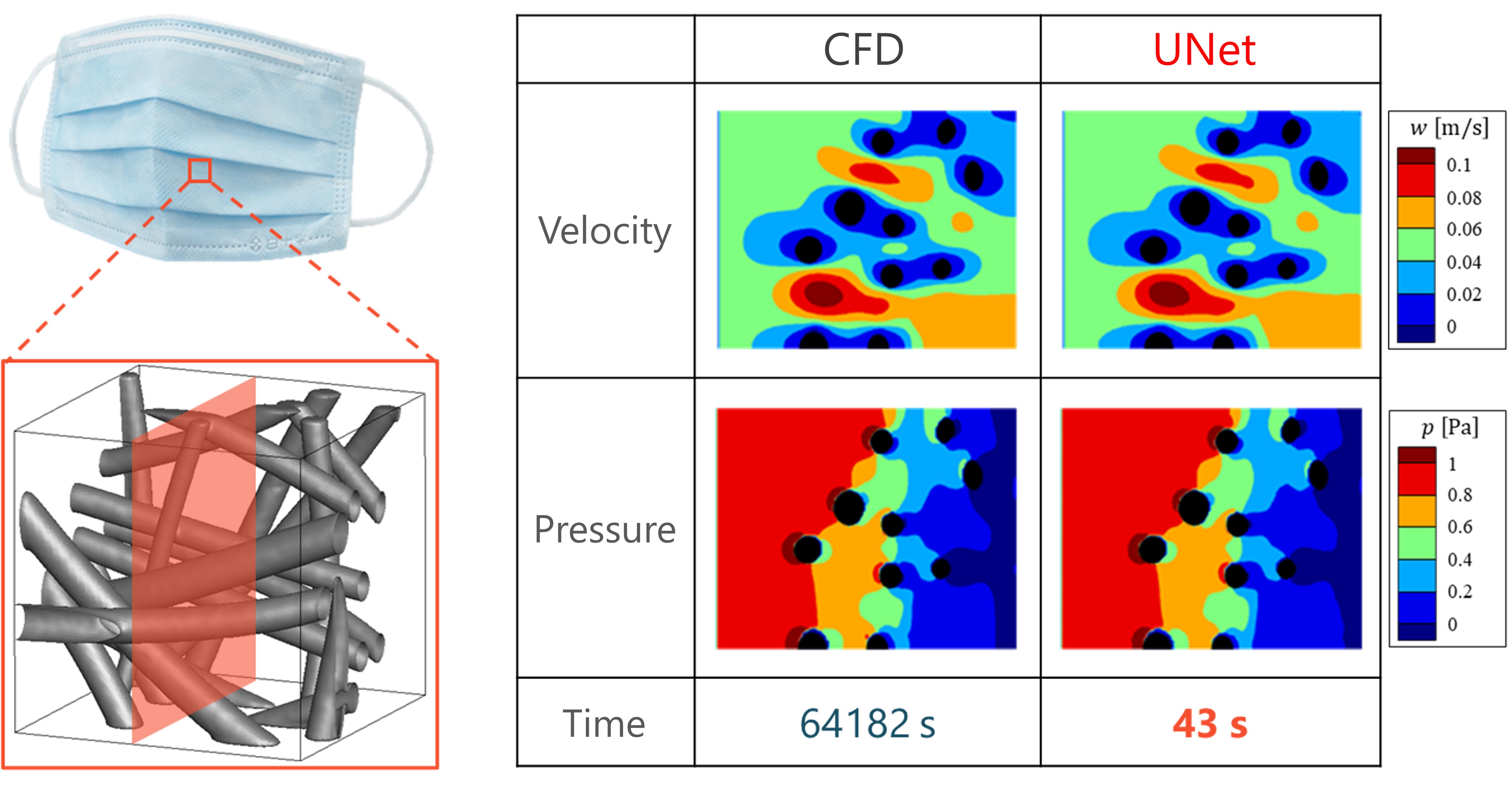
上述したように、分散系流れや複雑な流れを可視化し理解するためには、高解像度・高忠実度の数値シミュレーションが有用です。しかしながら、そのようなシミュレーションの計算コストは非常に高く、計算時間がかかります。そのため、プロセスの設計条件や装置、材料の最適設計を達成することが難しいという問題があります。本研究は、そのような欠点を克服するために、機械学習を利用するものです。我々は畳み込みニューラルネットワークの1種であるUNetと呼ばれるモデルに基づく深層学習モデルを開発しています。
High-resolution and high-fidelity simulations are powerful for visualizing and understanding dispersed flows, but their computational costs can be extremely high. This makes timely analysis and practical optimization of process conditions, devices, and materials difficult. To overcome these limitations, we leverage machine learning, including deep learning models based on U-Net architectures.
私たちのモデルでは、多孔質体の画像(微細構造の形状)からその内部の速度分布や圧力分布などを予測することができます。特筆するべきはその計算速度で、数値シミュレーションの1/1000倍未満の計算時間で詳細な予測を行うことができます。この技術はリアルタイム計算が必要とされる化学プロセスのデジタルツインへの応用が期待されます。
With our model, velocity and pressure distributions within porous media are predicted based on microstructure images. Most notably, the computation time is more than 1,000 times faster than numerical simulations, while still maintaining high fidelity. This breakthrough offers significant potential for the development of digital twins in chemical processes that require real-time computations.
また、機械学習を利用したデータ駆動最適化の研究も行っています。プロセスパラメータや設計パラメータとプロセス性能や材料・装置性能をそれぞれ入力・出力とした機械学習モデルを構築し、これを遺伝的アルゴリズムに基づく最適化ソルバーと連成することにより、短時間で効率的に設計空間を探索し、最適解を得ることができます。私たちはすでにこの技術を用いて、膜分離モジュール、ローターステーターミキサー、エアフィルター微細構造など様々な化学プロセスや材料の最適化を実現しました。
We also study data-driven optimization. By building machine learning models that map process/design parameters to performance metrics and coupling them with genetic-algorithm-based solvers, we can efficiently explore design spaces and obtain optimal solutions in short time. We have applied this approach to optimize membrane separation modules, rotor–stator mixers, and airfilter microstructures.